Researchers Build a Structural and Mechanistic Atlas of
SARS-CoV-2 NTD Antibody Neutralization and Immune Escape
The N-terminal domain (NTD) of the SARS-CoV-2 spike protein is an important antibody target, but its epitope organization, neutralization mechanisms, and immune escape patterns have remained incompletely understood.
A study led by Prof. Qihui Wang and Prof. George F. Gao from the Institute of Microbiology, Chinese Academy of Sciences (IMCAS) provides a unified structural and mechanistic framework for NTD-directed antibodies. By combining antibody competition assays with structural analyses, the researchers classified NTD antibodies into nine spatially distinct epitope classes, NTD-1 to NTD-9, including a cryptic epitope, NTD-8.
This work was published in the Proceedings of the National Academy of Sciences of the United States of America (PNAS) on August 5.
The researchers investigated how antibodies targeting different NTD regions neutralize SARS-CoV-2. They found most NTD antibodies depend strongly on bivalent binding, whereas selected antibodies targeting NTD-3, NTD-5, and NTD-9 retain substantial neutralizing activity even in Fab form. Notably, antibodies from the NTD-5 and NTD-9 classes can trigger shedding of the S1 subunit from the spike protein, thereby destabilizing the spike and interfering with viral entry.
To track how viral evolution reshapes NTD antibody recognition, the team profiled 41 monoclonal antibodies across the SARS-CoV-2 prototype, Delta, and 17 Omicron subvariants. The resulting epitope-resolved escape atlas showed that different NTD antibody classes are affected differently during viral evolution, with some broadly reactive antibodies retaining activity until relatively late Omicron subvariants emerged.
By integrating binding, neutralization, structural, mutational, and glycosylation analyses, the researchers identified three major immune escape strategies: disruption of antibody-contact residues, glycan shielding, and conformational remodeling. These mechanisms allow SARS-CoV-2 to reduce antibody recognition either by directly altering molecular contacts, masking epitopes with glycans, or reshaping local antigen structure.
A striking example was found in the Omicron subvariant KP.3.1.1. A single serine deletion at position 31 (ΔS31) creates a new glycosylation site at N30 while simultaneously remodeling the nearby S27-R34 region. These changes impair recognition by antibodies from both the NTD-5 and NTD-9 classes, revealing a dual escape mechanism that combines glycan shielding with conformational remodeling.
Together, these findings connect NTD epitope organization, antibody neutralization, and viral immune escape within a unified framework. These insights may help guide the development of antibodies and vaccines with greater resilience to continued antigenic drift.
This study is the latest in a series of systematic investigations by the teams of Prof. Qihui Wang and Prof. George F. Gao into the antigenic evolution of SARS-CoV-2. Building on an atlas of RBD-targeting neutralizing antibodies (Immunity, 2022; Cell Reports Medicine, 2023; Med, 2024), they established the first serotyping framework for the virus (Science Bulletin, 2023; eBioMedicine, 2025) and extended it step by step to six serotypes covering subvariants up to December 2024 (The Lancet Microbe, 2024 and 2025). The present study expands this effort from the RBD to the NTD.
The work was supported by the External Cooperation Program of the Chinese Academy of Sciences, the Project of Beijing Life Science Academy, and the National Natural Science Foundation of China.
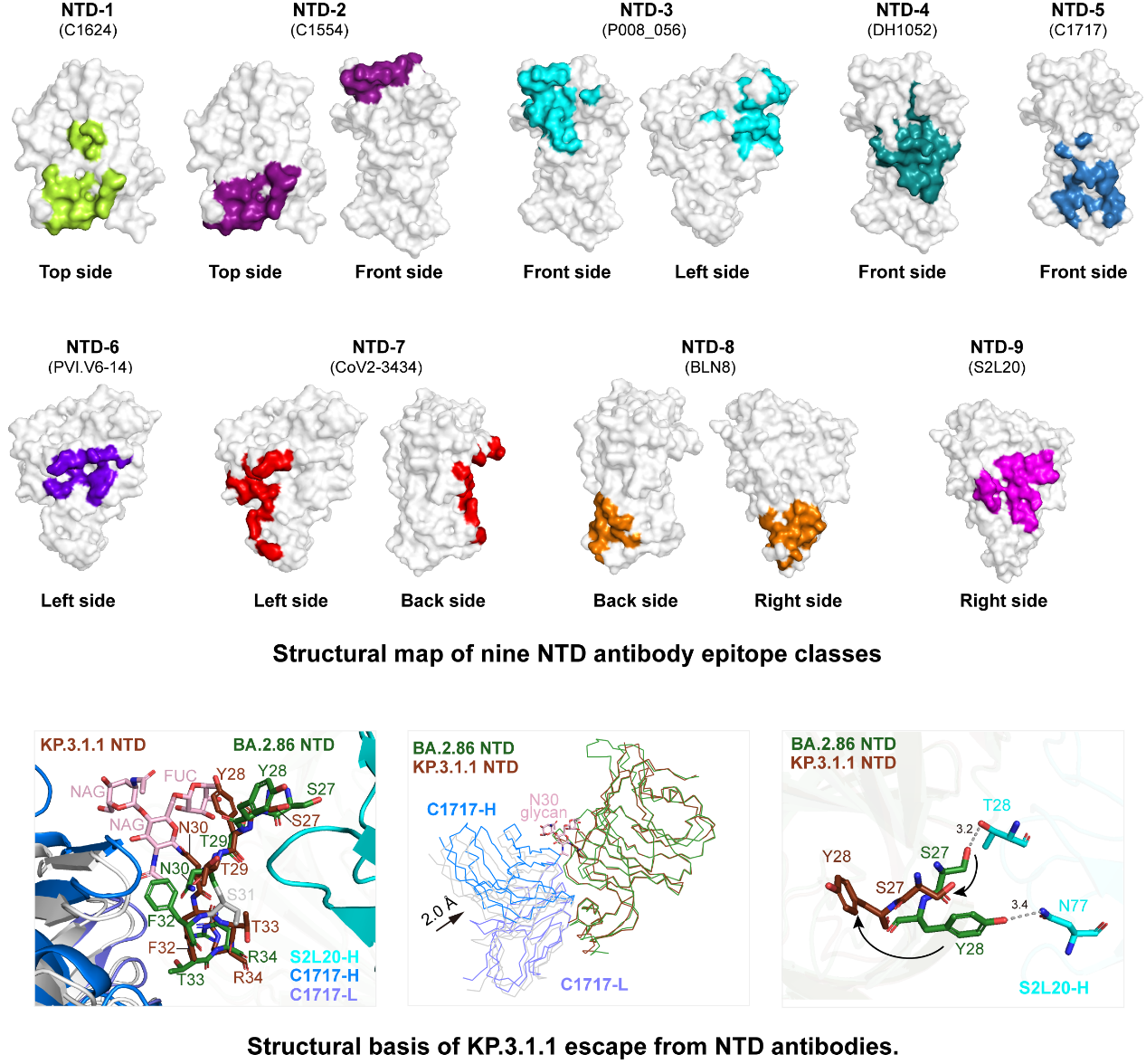
Nine NTD antibody epitope classes and the structural basis of KP.3.1.1 immune escape (Image by ZHOU Jianjie)
Full text link: A structural and mechanistic atlas of NTD antibody neutralization and immune escape across SARS-CoV-2 prototype and its(sub-)variants
 Appendix:






